STRATEGIC IA · AI-AUGMENTED DESIGN
Modularizing a multi-product home
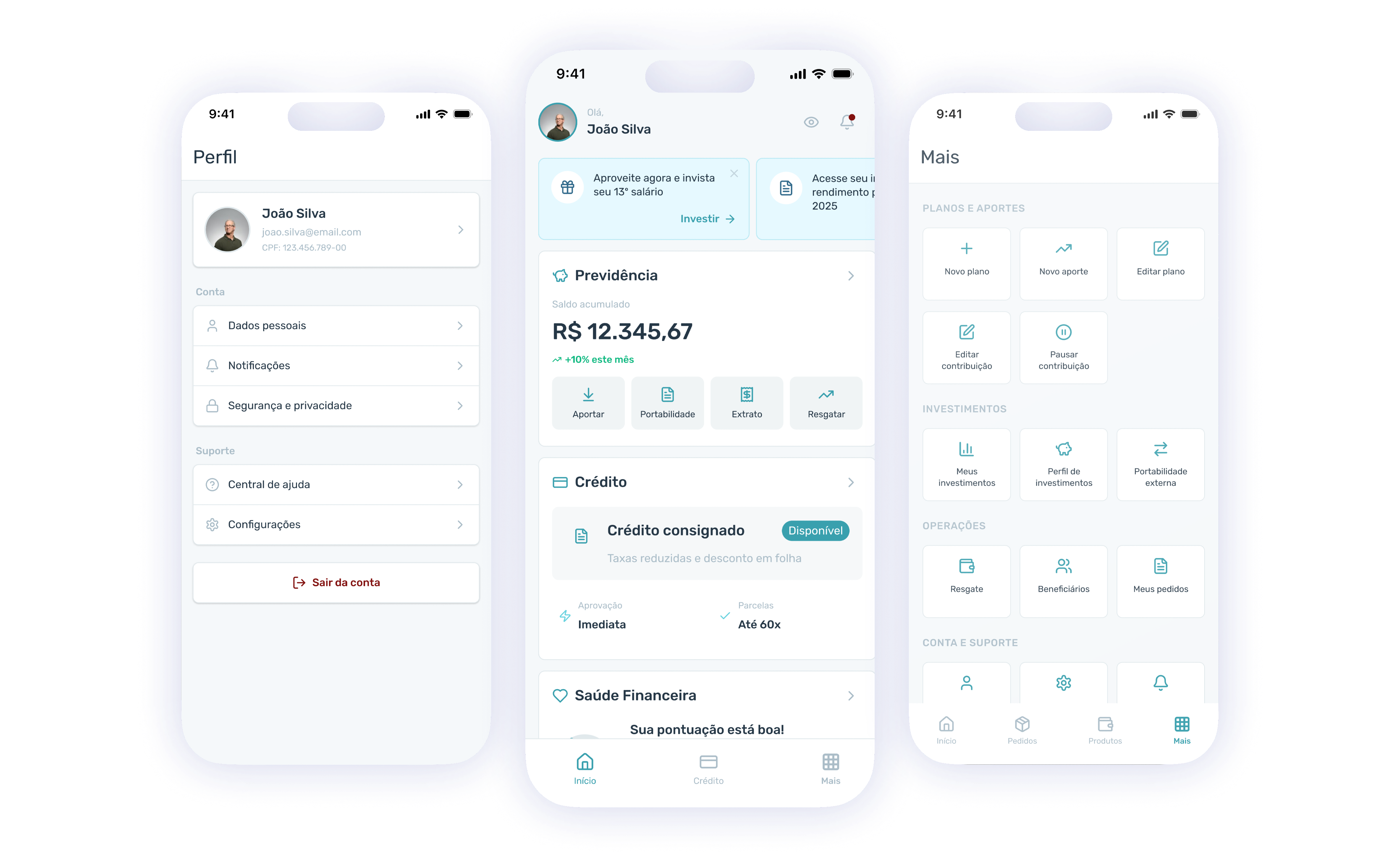
Redesigned the Onze app home — replacing a pension-first layout with a modular architecture that gives equal weight to every product line, with AI-augmented exploration throughout.
CONTEXT
The product
- CompanyOnze
- IndustryFintech • Multi-product (private pension • credit • financial health • insurance)
- ProductOnze app
- UsersEmployees with mixed access — some companies offer all four products, others only a subset
- StakesOnze evolved from a pension-only company into a multi-product fintech. The home, inherited from the original era, was still pension-first — limiting awareness of newer high-priority products like credit, the company's 2026 growth focus.
- Role
- Staff Product Designer
- Team
- Cross-squad Design • Product • Engineering
- Scope
- Home UX Architecture • Multi-product modularization
- Year
- 2026
THE PROBLEM
Where a pension-first home was holding the product back
The home was inherited from the era when Onze was a pension-only company. The product had since expanded into credit, financial health, and insurance — but the home didn't reflect that. C-level leadership flagged this as a strategic blocker for 2026, with credit identified as the company's growth priority.
01
Pension dominated the layout
Credit, financial health, and insurance were demoted to bottom menu links — limiting awareness of products central to Onze's 2026 strategy.
02
Rigid layouts created visible gaps
Different employees within the same client company had access to different products. The static layout left empty space where a product wasn't available — making the experience feel incomplete.
03
Visual language felt dated
Stakeholders and users reported the home looked older than the rest of the product — eroding the perception of Onze as a modern, multi-product fintech.
BUSINESS SIGNAL
This wasn't a UX redesign for craft reasons — it was a strategic move from the C-level to redistribute attention across all Onze products, with credit conversion as the explicit 2026 priority.
MY CONTRIBUTION
What I owned end-to-end
I participated in the cross-squad ideation from the start as part of the B2C squad — and assumed end-to-end ownership when the initiative needed someone to consolidate the team's work into a single, production-ready design. My pension domain depth from prior squads (enrollment, withdrawals, plan edits), combined with cross-product context and senior capacity, positioned me to carry it through.
I integrated AI tools (Lovable, Figma Make, ChatGPT) into the design process to explore card states, information density variations, and bottom menu restructures — treating AI as a force multiplier for synthesis, not a replacement for design judgment.
I led user testing with 6 Fintech stakeholders — HRs from 2 major client companies and Onze's operational team — using a structured prototype test with two moderators, surfacing actionable improvements that fed into the final design.
I owned final design decisions — credit prominence (limit + interest exposed upfront), pension preserved as primary card without visual dominance, and a 'Para você' module for fixed marketing surfaces — and built the final design package for C-level review (presented by Design Lead and Product Director).
PROCESS
How I got there
PHASE 01
Synthesis
PHASE 02
Architecture
PHASE 03
Validation & Refinement
PROCESS ARTIFACT
Wireframe consolidation — built using AI tools to synthesize cross-squad inputs into a single, evaluable artifact. Every card state and information variation was explored before locking into the final design.
SOLUTION
Five architectural decisions behind the redesign
| DECISION | RATIONALE |
|---|---|
| Modular card system | Every product as a self-contained card with equal visual weight. When a user doesn't have a product, the card simply isn't rendered — no empty space, no broken feel. |
| Credit prominence | Credit card surfaces the available limit and interest rate upfront — turning a passive entry point into an active conversion surface, aligned with the 2026 priority. |
| Pension preserved, not dominant | Pension stays as the first card (still core to Onze's identity) but loses visual weight. Recognition without monopoly. |
| 'Para você' module | A fixed strip for marketing campaigns and dynamic content — replacing the previous pattern of seasonal cards floating in the layout. |
| Financial health surfaced | Elevated visibility of an existing financial health score test after C-level feedback that this paid-tier product needed weight equivalent to credit's prominence — surfacing it via existing content rather than creating new components. |
FINAL WIREFRAME
The wireframe that became the foundation of the delivered design — synthesized with AI tools from cross-squad inputs.
VALIDATION
What the testing surfaced
When does this go live? I want to show my employees tomorrow. This is awesome.
OTHER FINDINGS FROM THE TEST
Modular layout helped users immediately identify which products were available to them — a critical insight given the variability across client companies.
Stakeholders praised the visual refresh — the previous home was perceived as dated, which had been eroding the modernity associated with the Onze brand.
Surfaced an action item: 'Fale conosco' (support contact) needed to be more visible — incorporated into the final design.
LEARNINGS
What this taught me
AI works best as a synthesis force multiplier, not a generation shortcut. Across this project, Lovable, Figma Make, and ChatGPT helped me explore card states, test information densities, and rethink the bottom menu — but every variation still passed through design judgment, design system constraints, and stakeholder validation. AI accelerated the exploration; it didn't replace the decisions.
Strategic initiatives often need someone to step up — not because the brief assigned ownership, but because the work demands consolidation. Taking that role required active participation in the ideation phase to understand every squad's input, then translating that collective work into a single design that could be tested, defended, and shipped. That kind of emergent ownership is invisible in portfolios but central to how design actually lands in mature organizations.
Want to see the final solution?
The final home design is under NDA until launch — happy to share it directly. Also up for a deeper conversation about AI in design or cross-squad synthesis.
CONTINUE READING